CFD Direct Year 7: 2021-2022

CFD Direct Year 7: 2021-2022

In Year 7 of CFD Direct, our developments of OpenFOAM included a generalised load balancer for parallel running . We provided core maintenance, including standardisation of fluid properties, and repaired issues, e.g. to stablise multiphase simulations. We managed the OpenFOAM Foundation, releasing OpenFOAM v9, packaging OpenFOAM-dev and publishing websites and documentation. We produced our book , “Notes on Computational Fluid Dynamics: General Principles”, delivered 56 days of Live Virtual OpenFOAM Training, and provided cloud CFD with CFDDFC® to over 1000 subscribers.

CFD Book for OpenFOAM

CFD Book for OpenFOAM

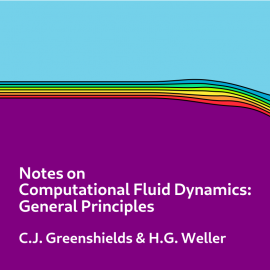
CFD Direct is delighted to announce its publication of a book Notes on Computational Fluid Dynamics: General Principles. The book is written for people who use CFD in their work, research or study, providing essential knowledge to perform CFD analysis with confidence. It offers a modern perspective on CFD with the finite volume method, as implemented in OpenFOAM and other popular general-purpose CFD software. Fluid dynamics, turbulence (and RAS modelling) and boundary conditions are presented alongside the numerical methods and algorithms in a series of short, digestible notes.

OpenFOAM Models & Constraints

OpenFOAM Models & Constraints

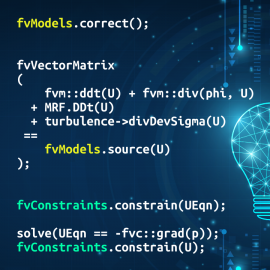
In March 2021, CFD Direct replaced fvOptions with new fvModels and fvConstraints classes. fvModels provided a more complete framework for implementation of complex models which could be optionally selected during a simulation. New fvModels were implemented for heat transfer and sources, which are easier to configure than a general fvOption. Pressure limiting was implemented as an fvConstraint named limitPressure, consistent with limitVelocity and limitTemperature. With additional fvModels such as cloud and surfaceFilm, solvers such as reactingFoam replicate the functionality of several existing solvers which are deprecated.

Useful Tools in OpenFOAM

Useful Tools in OpenFOAM

We design our OpenFOAM Training so that users can learn effective CFD, giving them the confidence to carry out CFD analysis, repeatedly, to a defined standard in a timely manner. We provide 4 courses that teach reliable procedures to configure, run and maintain CFD simulations. While creating and improving these courses, we have contributed useful tools to OpenFOAM for more productive CFD, so that users waste less time on routine tasks. They include the post-processing command line interface, template cases, and tools for case setup, monitoring simulations, quick documentation and code customisation.

CFD Direct Year 6: 2020-2021

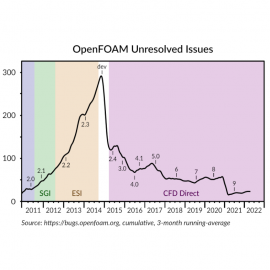
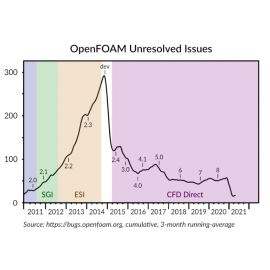
OpenFOAM Unresolved Issues

In Year 6 of CFD Direct, our developments of OpenFOAM included new interface capturing methods and multicomponent transport models. We provided core maintenance, including redesign of fvOptions and transport modelling, and repaired issues, e.g. in meshing and conjugate heat transfer. We managed the OpenFOAM Foundation, releasing OpenFOAM v8, packaging OpenFOAM-dev and publishing websites and documentation. During the Covid restrictions, we delivered 67 days of Live Virtual OpenFOAM Training, and provided cloud CFD with CFDDFC® to over 700 subscribers.

Redesigning OpenFOAM for the Future

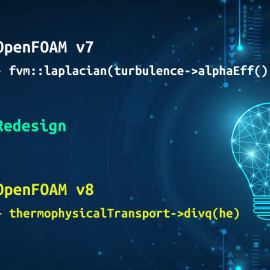
OpenFOAM Redesign

In 2020, CFD Direct were tasked to develop multicomponent diffusion modelling in OpenFOAM with funding from the Process Engineering Consortium. The Consortium need models, e.g. Maxwell-Stefan, that represent complex diffusion of species in fluid mixtures, affecting both specie concentration and energy. As part of the work, we created a new ThermophysicalTransportModels library with a new interfaces for: fluxes of heat, q() and divq(); and fluxes of mass, j() and divj(). As a consequence, heat transfer became consistent across applications, boundary conditions and data processing. This critical code redesign is typical of our strategy for sustainable development of OpenFOAM, supported by dedicated maintenance funding from OpenFOAM supporters.