CFD Direct has an OpenFOAM Training course catalogue that includes 5 courses of 12 days duration. The courses are updated as OpenFOAM evolves with successive releases. Workflows, examples, functionality and recommendations in the courses have changed significantly over the past few years. Previous attendees of our training are now asking whether they should renew their training with us. To help answer that question, this article describes why, what and when updates have been made to our OpenFOAM Training.
Background to OpenFOAM Training
Chris Greenshields and Jenya Collings pioneered professional OpenFOAM Training in 2008. They began with two 2-day courses which they delivered and managed until 2014, before founding CFD Direct with Henry Weller to provide a stable environment for OpenFOAM development and maintenance. This new start provided the opportunity to reimagine CFD training with OpenFOAM and write two new courses from scratch, Essential CFD and Applied CFD, which were launched in 2015. A third course, Programming CFD, was written shortly afterwards and launched in the spring of 2016. Finally, in 2024, Productive CFD, consisting of two more 2-day courses was written and launched.
New Features in OpenFOAM
OpenFOAM, released via The OpenFOAM Foundation, is produced by CFD Direct. For some time it has been recognised as the best version of OpenFOAM compared to other variants and forks — and the gap is widening. Since CFD Direct makes Foundation OpenFOAM better with every release, the latest version, currently OpenFOAM v14, leads the field. Each new version includes developments that improve the robustness, extensibility and usability of OpenFOAM, including:
- useful tools, e.g. foamInfo, foamToC, and foamDictionary, which should be part of the CFD workflow of every OpenFOAM user;
- general features such as units and field functions for field initialisation and coded file input for case configuration;
- modern functionality such as modular solvers, non-conformal coupling (NCC), modular Lagrangian (particles), dynamic zones, etc.
Updates to OpenFOAM Training
As OpenFOAM improves, users can reliably undertake increasingly complex calculations. At the same time, their workflows must remain manageable or become simpler through sensible adoption of new tools and features. To help with this, we update our our OpenFOAM Training courses to include new tools and features as they are introduced to OpenFOAM. The emergence of a new tool, e.g. snappyHexMeshConfig (configuration tool for snappyHexMesh), or new functionality, e.g. NCC, can cause a recurring change to workflows throughout the training. Some new functionality caused entire modules to be (re)written, e.g. for modular Lagrangian in Applied CFD and modular solvers in Programming CFD.
Changes from OpenFOAM v8 to v14
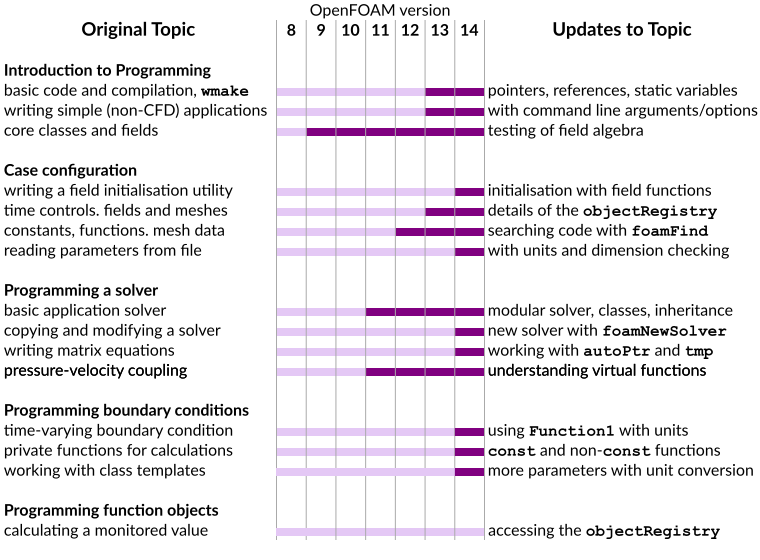
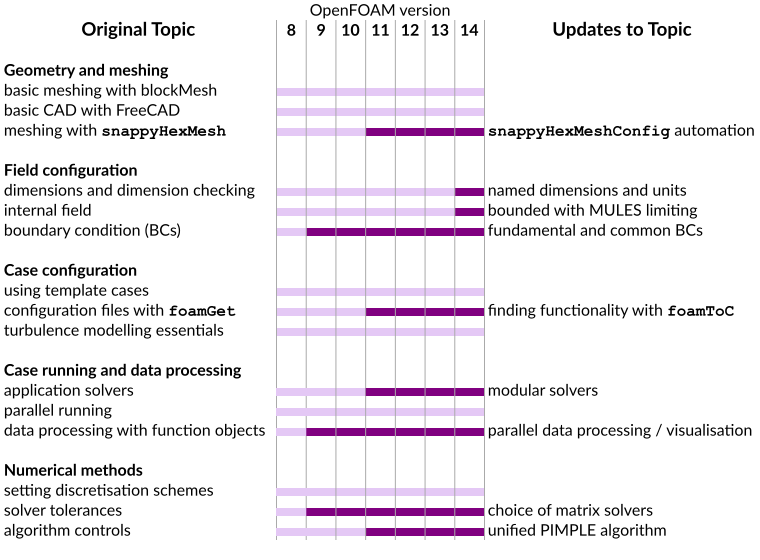
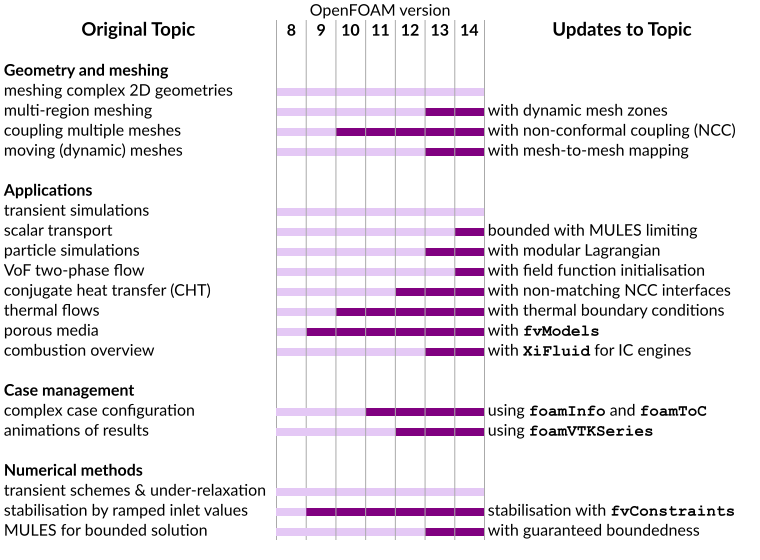
The introduction of new tools and features in Foundation OpenFOAM accelerated significantly around 2020, beginning with the redesign of transport modelling in OpenFOAM v8. Since then there have been many changes to our courses, which are difficult to describe in their entirety. The following graphics provide an overview of the updates — either replacements or additions — to topics in the Essential, Applied and Programming CFD courses. Returning to the question of when users should renew their training with us, there are clearly a lot of changes since OpenFOAM v8 in 2020 and even since OpenFOAM v10 in 2022. A lot of updates were then made for OpenFOAM v11 in 2023 and since then Applied CFD is the course which has changed the most. Further updates are also in progress to Programming CFD, following the release of OpenFOAM v14, which will be in place in the Autumn (Fall) of 2026.
Essential CFD
Applied CFD
Programming CFD